Following the recent discovery of the first
semi-aquatic and largest dinosaur found in Morocco last September, we contacted Dr. Nizar Ibrahim,
the paleontologist who discovered it, on the behalf of the Moroccan Chapter of
the Young Earth Scientists (YES) Network to know more about this dinosaur but
also to have his opinion about the Moroccan paleontological heritage. He has
kindly and immediately responded to our interview request and we highly
appreciate his cooperation.
 |
Photo of Nizar Ibrahim while being interviewd by the
National Geographic on the Spinosaurus discovery.
Credits: National Geographic
|
1. Can you give us a brief insight on your
background and the focus of your research in Palaeontology?
I am a German-Moroccan paleontologist and comparative anatomist. I received
my undergraduate degree from the University of Bristol (UK) and my PhD from
University College Dublin (Ireland). I am now based at the University of
Chicago (Department of Organismal Biology and Anatomy). My research is
currently focused on the evolutionary history, diversity and paleoecology of
Cretaceous vertebrates found in North Africa. I have also carried out research
in the field of bioinformatics, bridging the fields of genetics, anatomy and
developmental biology.
2. What was the context of the discovery of the semi-aquatic Spinosaurus?
How can you describe this dinosaur compared to the other ones already found in
Morocco and elsewhere?
Spinosaurus is unique in many different ways. It is the largest predatory
dinosaur known to date, but more importantly it is the first dinosaur showing
unmistakable adaptations for a semi aquatic lifestyle. It looked really
different from other predatory dinosaurs: long narrow jaws, long neck, giant
"sail" on the back, paddle-like feet…
 |
BUILDING THE BEAST: Modern tools bring ancient bones back to life and reveal Spinausorus.
|
3.What are the implications of this discovery as far as Theropods
sub-order is concerned and how can we situate it more generally in terms of
vertebrate evolution?
Spinosaurus shows us that dinosaurs were more diverse and adaptable than we
thought. Spinosaurus lived in a large river system, full of
giant fish, crocodile-like predators, turtles etc – abundant prey for a
dinosaur that can hunt in the water. These unique adaptations for fish eating
allowed Spinosaurus to coexist with other (more typical) predatory dinosaurs.
4. Do you plan to do more "Spinosaurus hunting" in Morocco or in
North Africa? Morocco is known for its geodiversity, especially the
palaeontological one. How do you perceive the level of valorization of this
geoheritage in the country and how do you think this discovery will impact the
palaeontological and more generally the geological society in Morocco?
Yes, the Sahara is full of fossil treasures, so in all likelihood I will be
working in North Africa for many years to come.
Morocco has a very rich paleontological heritage, recording key moments of
what is without a shadow of a doubt the most incredible story out there: the
history of life on our planet. Unfortunately many Moroccans do not known this.
I am trying to change this – the Spinosaurus discovery is certainly
going to help. Morocco needs at least 4 or 5 natural history museums
to house the many paleontological and zoological treasures the country has
to offer. I am currently working with Moroccan colleagues and partners on large
scale museum projects – and I am quite confident that we
can move things in the right direction very soon.
Note: Images used in this article are from "the October issue ofNational Geographic magazine”. You can check it out on the following link: http://goo.gl/wEUGeX
Interview by Amel Barich & Zaineb Hajjar
Supported by Salma Tifratine


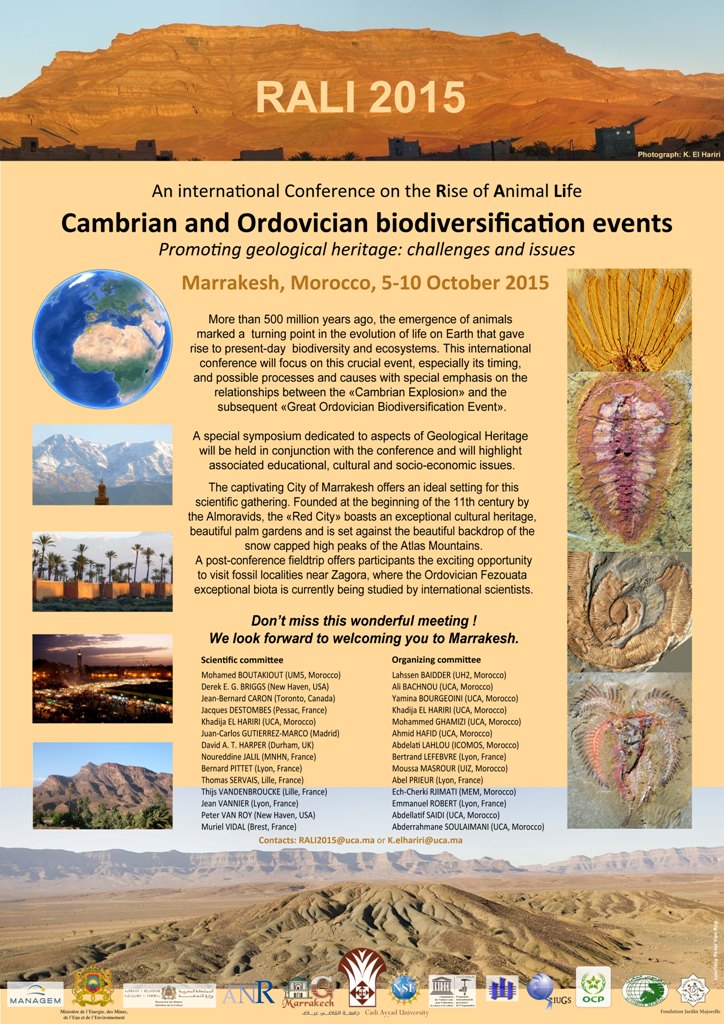
 A special
symposium dedicated to aspects of Geological Heritage will be held in
conjunction with the conference and will highlight associated educational,
cultural and socio-economic issues.
A special
symposium dedicated to aspects of Geological Heritage will be held in
conjunction with the conference and will highlight associated educational,
cultural and socio-economic issues.